









In the world of industrial design, choosing a Neodymium (NdFeB) magnet involves more than just picking the “strongest” grade. It is a calculated balance between Magnetic Flux Density (Br), Temperature Stability (H{cj}), and Cost-Efficiency.
While a standard N52 magnet offers peak room-temperature strength, it may fail catastrophically in an EV motor or a high-speed pump. You will take 1 minute to learn about Neodymium Magnet Grades in this guide.
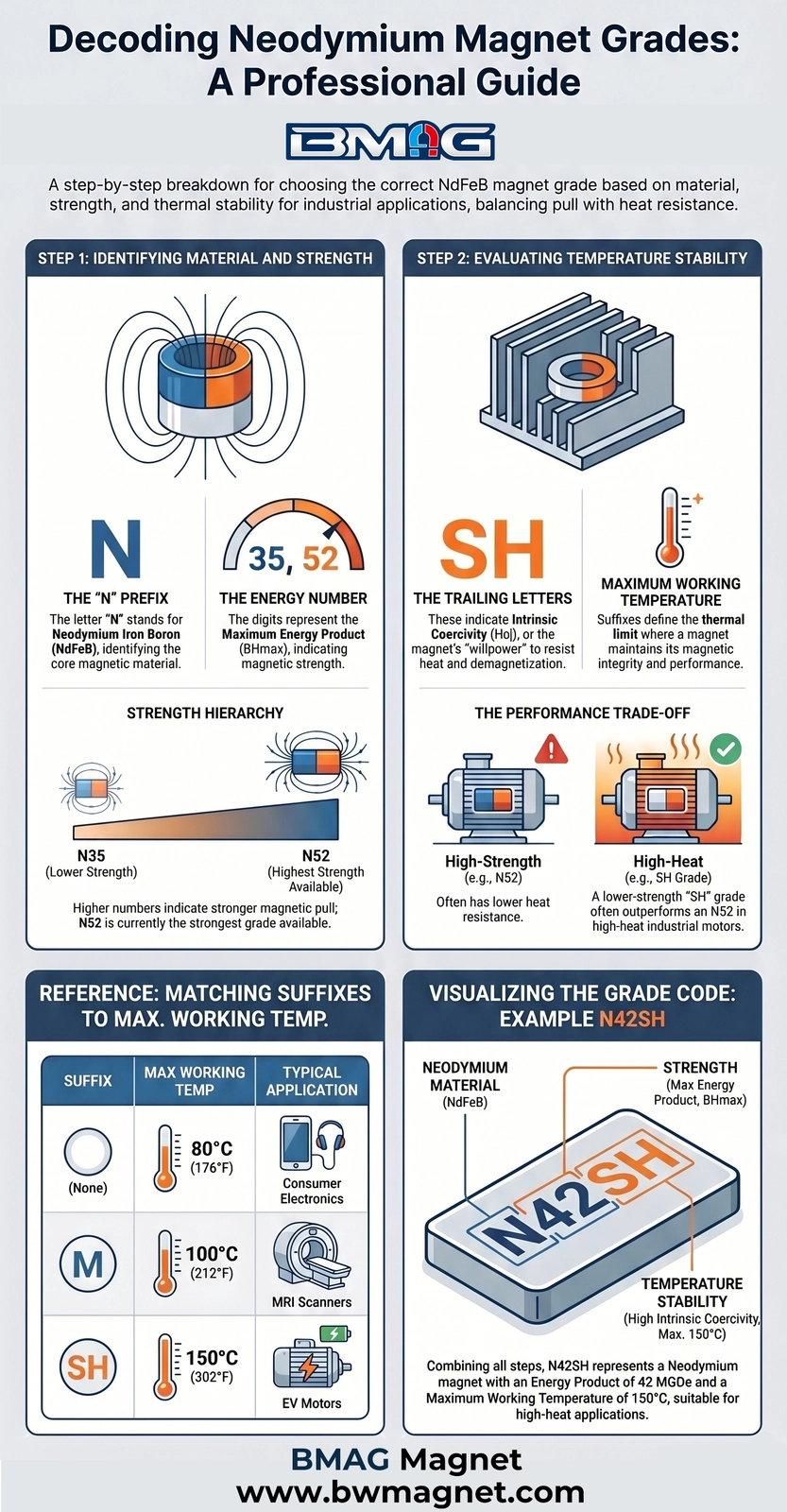
1. The Physics of the Grade: Br vs. Hcj
A magnet’s grade (e.g., N42SH) tells two stories: how much “pull” it has and how well it resists “dying” under heat.
- The Number (The Br Factor): Represents the Maximum Energy Product (BH{max}). A higher number indicates a higher Remanence (Br), which translates to a stronger magnetic field.
- The Letters (The H{cj} Factor): These indicate the Intrinsic Coercivity. This is the magnet’s “willpower” to stay magnetized when exposed to high temperatures or opposing magnetic fields.
Technical Specification Overview
| Grade Series | Max Working Temp | Remanence (Br) | Intrinsic Coercivity (Hcj) | Typical Application |
| N Series | ≤ 80℃ | 1.17 – 1.48 T | ≥ 12 kOe | Consumer electronics, office supplies |
| M Series | ≤ 100℃ | 1.17 – 1.45 T | ≥ 14 kOe | High-end speakers, MRI scanners |
| H Series | ≤ 120℃ | 1.14 – 1.41 T | ≥ 17 kOe | Standard industrial sensors |
| SH Series | ≤ 150℃ | 1.11 – 1.35 T | ≥ 20 kOe | EV Motors, high-speed rotors |
| UH Series | ≤ 180℃ | 1.05 – 1.25 T | $≥ 25 kOe | Automotive under-the-hood sensors |
| EH/AH Series | ≤ 220℃ | 0.98 – 1.15 T | ≥ 30 kOe | Aerospace, deep-hole drilling gear |
2. Engineering Trade-offs: Why N42SH Often Beats N52
A common mistake in B2B procurement is over-specifying the magnetic strength while under-specifying thermal resistance.
The Scenario: You are designing a high-performance brushless motor that operates at $130^\circ\text{C}$.
- The N52 Choice: On paper, it is the strongest. However, its max working temperature is only $80^\circ\text{C}$. At $130^\circ\text{C}$, it will suffer permanent demagnetization, causing the motor to fail.
- The N42SH Choice: While its initial “pull” is lower than N52 at room temperature, it maintains its magnetic integrity up to $150^\circ\text{C}$. In a hot motor environment, the N42SH will actually provide more torque and stability than the N52.
3. Industry-Specific Applications
Automotive & EV Powertrains
The demand for high-efficiency motors requires grades like 38SH to 45UH. These grades balance the high torque required for acceleration with the extreme heat generated by high-frequency switching in the inverter.
Industrial Automation & Robotics
Precision is key. For robotic arms and CNC actuators, N42H or N45SH are industry favorites. They provide the necessary “snap” for fast movements while ensuring long-term reliability in non-climate-controlled factory floors.
Clean Energy: Wind Turbines
Direct-drive wind turbines use massive quantities of Neodymium. Here, cost-efficiency is paramount. Large-scale projects often utilize N40SH or N42SH to ensure the generators can withstand 20+ years of seasonal temperature fluctuations without losing power output.
4. Strategic Sourcing: Balancing Performance and Cost
As an industrial partner, BMAG recommends the following for your procurement strategy:
- Don’t Over-Spec: If your application never exceeds $60^\circ\text{C}$, paying the premium for “SH” or “UH” grades is an unnecessary cost. Stick to the “N” series.
- Geometry Matters: A thin magnet demagnetizes more easily than a thick one. If your design is constrained to a thin profile, you may need a higher coercivity letter (e.g., opting for “SH” instead of “H”) to compensate for the “Self-Demagnetizing Field.”
- Coating is Essential: Neodymium is prone to oxidation. For industrial environments, ensure you specify Ni-Cu-Ni (standard), Zinc (cost-effective), or Epoxy (high salt-spray resistance).
Summary
Choosing the right NdFeB grade is a balance of science and budget. While the “N-Number” gets the headlines for strength, the “Letter” ensures your project doesn’t fail in the field.
Need a custom technical consultation for your project? Contact the BMAG Engineering Team for specific Gauss readings and material testing reports.