








In the journey of a high-performance BMAG magnet, the manufacturing process—from melting to precision machining—creates a component with the potential for immense power. However, until the very final stage, that component remains a dormant piece of metal. Magnet magnetization is the transformative process that “wakes up” the material, aligning its internal structure to create the permanent magnetic field we rely on for modern technology.
For engineers and procurement professionals, understanding the science of magnet magnetization is critical for ensuring that a component performs to its rated grade, whether it is an N35 consumer grade or an ultra-high coercivity N52SH automotive grade.
What is Magnet Magnetization?
At its simplest, magnet magnetization is the process of inducing a permanent magnetic field into a magnetic material. While the material has the chemical composition to be magnetic, it requires an external force to align its internal “magnetic dipoles” in a single direction.
The Magnetic Material in its Raw State
It is a common misconception that rare-earth materials like Neodymium-Iron-Boron Nd2Fe14B are magnetic the moment they are created. In their raw, unmagnetized state, these materials consist of billions of microscopic “magnetic domains.” In an unmagnetized block, these domains are oriented randomly, pointing in different directions and effectively canceling each other out. The result is a net-zero magnetic field.
The Principle of Magnet Magnetization
The core principle of magnetization involves subjecting the material to an external magnetic field that is significantly stronger than the material’s own Coercitività intrinseca Hcj.

When this powerful external field is applied, it forces the randomly oriented magnetic domains to rotate and align with the field lines. For sintered NdFeB magnets, which possess a tetragonal crystal structure, this alignment is most effective along the “easy axis” or c-axis. Once the external field is removed, the high coercivity of the Neodymium alloy prevents the domains from returning to their chaotic state, resulting in a permanent magnet.
The Direction of Magnet Magnetization
Unlike isotropic magnets (which can be magnetized in any direction), BMAG sintered magnets are anisotropo. This means they have a “preferred” direction of magnetization established during the Phase III pressing process.
The direction of magnetization must be clearly defined during the design phase:
- Axial Magnetization: The field runs through the length or thickness of the magnet (e.g., from one flat face to the other).
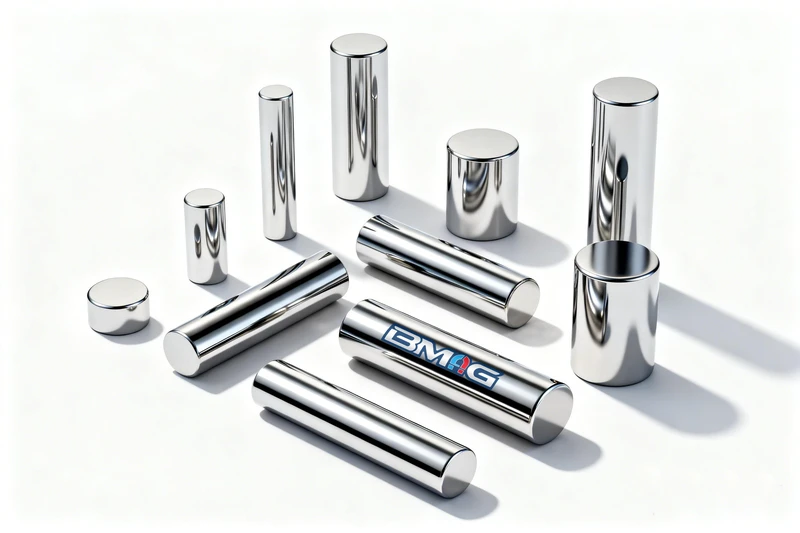
- Diametric Magnetization: The field runs across the diameter of a cylinder or disc.
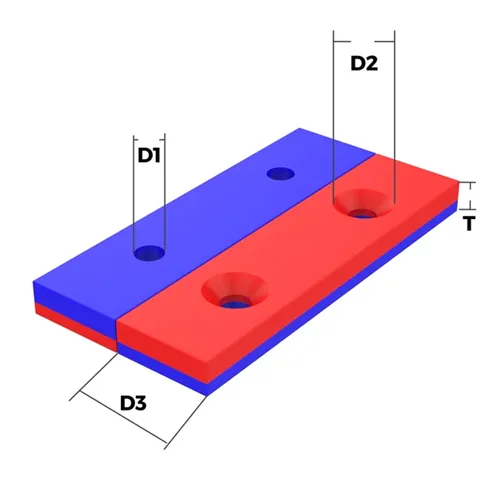
- Multi-pole Magnetization: Creating multiple North and South poles on a single face, often used in precision sensors or high-efficiency motor rotors.
Ensuring the magnetizing fixture aligns perfectly with the magnet’s “easy axis” is vital; any misalignment will result in a significant loss of magnetic flux.

Does a Larger Current Result in a Stronger Magnet?
A frequent question in magnet engineering is whether increasing the electrical current during magnetization will “impart” more strength to the magnet. The answer is: Yes, but there are preconditions.
To fully “charge” a magnet, the external field must reach saturation. For NdFeB, the magnetizing field must be 3 to 5 times the coercivity of the material.
- Under-saturation: If the current is too low, only some domains will align, resulting in a magnet that is weaker than its rated grade.
- Saturation: Once all domains are perfectly aligned, the magnet has reached its maximum potential Br.
- Over-saturation: Increasing the current beyond the saturation point provides no additional magnetic strength. It will only consume more electricity.
Magnetization Equipment: The Capacitor Discharge Magnetizer
At the BMAG factory, magnetization is achieved using a Capacitor Discharge Magnetizer.

How it Works
- Energy Storage: The machine uses massive capacitor banks to store high-voltage electrical energy.
- The Pulse: This energy is released in a micro-second burst (a “pulse”) through a custom-built magnetizing coil or fixture.
- The Field: The sudden burst of energy creates a localized magnetic field of immense intensity—often exceeding 3.0 to 5.0 Tesla—which is more than enough to saturate the highest grades of NdFeB.
Magnetizing Fixtures
The “fixture” is the copper coil or assembly that holds the magnet during the pulse. Because of the extreme forces involved during the pulse, these fixtures must be built with high mechanical strength and efficient cooling systems to handle mass production.
Post-Magnetization: Verification and Quality Control
Once the magnetization process is complete, the magnet is finally a functional tool. However, BMAG’s quality control process requires immediate verification to ensure that the magnet products delivered to customers are fully qualified.

Measuring Success
- Gaussmeters: Used to measure the Induzione magnetica (B) at a specific point on the surface of the magnet.
- Fluxmeters & Helmholtz Coils: These are used to measure the Total Magnetic Flux. This is a more accurate representation of the magnet’s overall power than a single-point Gauss reading.
- Magnetic Field Mapping: For complex multi-pole magnets, we use automated scanners to map the field distribution across the surface, ensuring there are no “weak spots”.
Summary of the BMAG Magnetization Standard
Magnet magnetization is the final seal of quality in our production line. By ensuring that every magnet reaches full saturation through precisely controlled capacitor pulses, BMAG guarantees that our magnets meet the rigorous demands of modern industry.
- Precision Alignment: Matching the magnetizing field to the material’s anisotropy.
- Saturation Guarantee: Using 3–5x coercivity fields to reach the material’s full potential.
- Advanced Equipment: Utilizing high-voltage capacitor discharge technology for consistent results.
Are you developing a motor or sensor that requires a complex multi-pole magnetization pattern? Contact the BMAG engineering team today to discuss a custom magnet design for your specific magnetization needs.