








A
Air Gap
A low‑permeability interruption or gap within the magnetic flux path in a magnetic circuit. Although usually composed of air, this term also includes any non‑magnetic medium such as coatings, paint, or aluminum spacers. An air gap introduces a large increase in magnetic reluctance, meaning greater magnetomotive force is needed to sustain the target flux density across the gap.
AlNiCo
A group of permanent magnet alloys primarily made from aluminum, nickel, cobalt, and iron. These materials are known for high remanence and excellent thermal stability, retaining magnetic performance in moderately corrosive environments and at elevated temperatures.
Am (Area of Magnet)
The cross‑sectional area of the magnet perpendicular to its central magnetic flux line, measured in square centimeters (sq. cm.) at a given location. In engineering design calculations, Am is typically defined at the magnet’s neutral section.
Anisotropic
Describes a material whose magnetic properties differ depending on the direction of measurement or magnetization. Anisotropic magnets have a preferred “easy” magnetization axis, established during manufacturing through either geometric forming or magnetocrystalline alignment.
As (Area of air gap)
The average cross‑sectional area of the air gap region where functional magnetic interaction occurs, measured in square centimeters (sq. cm.) in a plane normal to the central flux line.
A.S.T.M.
The American Society for Testing and Materials, an international organization that develops and publishes voluntary technical standards for materials, products, systems, and services.
Axially Magnetized
A magnet magnetized between two flat, parallel end surfaces, with its north and south magnetic poles located on these opposing faces.
B
Bd (Remnant Induction)
The magnetic induction remaining in a magnetic material after an applied saturating magnetic field Hs has been removed. Units: Gauss.
Bd/Hd (Slope of Operating Line)
The ratio of remnant induction to demagnetizing field strength. This is equivalent to the permeance coefficient Pc, and is also referred to as the shear line, load line, or unit permeance.
BdHd (Energy Product)
The magnetic energy that a material can deliver to an external circuit when operating at a specific point on its demagnetization curve. Units: Megagauss‑Oersteds (MGOe).
(BH)max (Maximum Energy Product)

The highest value of the product of Bd and Hd on the demagnetization curve. It serves as the key indicator of a magnetic material’s potential energy output.
Bi (Intrinsic Induction)
The unique contribution of the magnetic material itself to the total magnetic induction (B). It is defined as the vector difference between the induction in the material and the induction that would exist in a vacuum under the same field strength (H). Formula: Bi = B − H (Note: Bi and B are in Gauss; H is in Oersteds. For SI conversion, 1 A/m = 0.01256 Oe).
Bis (Saturation Intrinsic Induction)
The maximum achievable intrinsic induction in a given magnetic material under saturation conditions.
Bm (Recoil Induction)
The magnetic induction present in a magnetized material after magnetization and subsequent stabilization for end‑use application. Units: Gauss.
Br (Residual Induction)
The magnetic induction that remains in a magnetic material at zero applied magnetizing force, following saturation in a closed magnetic circuit. Units: Gauss.
B-H Curve
A graphical representation showing the relationship between magnetic flux density (B) and applied magnetic field strength (H).
C
C.G.S.
The Centimeter‑Gram‑Second system of units, a historical metric system widely used in magnetism.
Closed Circuit
A configuration in which the entire external magnetic flux path of a magnet is contained within high‑permeability materials, minimizing flux leakage and enabling efficient flux circulation from the North pole to the South pole.
Coercive Force (Hc)
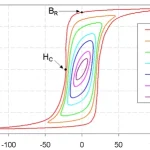
The demagnetizing field strength required to reduce the residual induction Br of a previously saturated magnetic material to zero. Units: Oersteds.
Coercive Force – Normal (HcB)
The applied magnetic field required to reduce the normal magnetic induction (B) to zero.
Coercive Force – Intrinsic (Hci)
A critical parameter representing a material’s inherent resistance to demagnetization. It is the field strength needed to reduce the intrinsic induction (Bi) to zero. Units: Oersteds.
Curie Temperature (Tc)
The characteristic temperature above which a ferromagnetic alloy loses its spontaneous magnetization and ferromagnetic behavior due to structural changes at the atomic level.
D
Demagnetization
The process by which the magnetic flux inside a magnet is reduced to a lower level or eliminated, commonly caused by high temperatures, external opposing magnetic fields, or open‑circuit operation.
Demagnetization Curve
The second quadrant of the major hysteresis loop, which characterizes the magnetic behavior and performance of a material under real‑world operating load conditions.
Demagnetization Force
Any external or internal influence — including opposing magnetic fields, thermal shock, mechanical impact, or vibration — that acts to reduce the magnetization level of a magnetic material.
Density
The mass of a material per unit volume, typically expressed in grams per cubic centimeter (g/cm³).
Diamagnetic
Materials with magnetic permeability slightly less than 1 (such as copper, silver, and gold) that produce a weak repulsive force when exposed to an external magnetic field.
Diametrically Magnetized
Cylindrical magnets in which the direction of magnetization runs parallel to the diameter, rather than along the central axial length.
Dimension Ratio
The ratio of a magnet’s magnetic length to its diameter (or equivalent diameter for non‑round shapes).
Dimensional Tolerance
The allowable range of deviation from the nominal dimensions of a finished magnet, reflecting practical manufacturing limits.
Domains
Microscopic regions within a magnetic alloy where the magnetic moments of atoms are aligned uniformly, creating a single shared magnetic direction.
E
Eddy Currents
Circulating electrical currents induced within conductive materials when exposed to changing magnetic fields. These currents generate opposing magnetic forces and can result in unwanted thermal losses or be harnessed for magnetic damping.
Electromagnet
A temporary magnet consisting of a solenoid wound around a ferromagnetic core; it generates a magnetic field only while electric current is applied.
Electro-Motive Force (e.m.f.)
The quantity of work per unit charge. Units: Volts.
F
F (Leakage Factor)
A dimensionless ratio that accounts for flux leakage from the magnetic circuit. It is defined as the ratio between the magnetic flux at the magnet’s neutral section and the average flux in the air gap: F=(BmAm)/(BgAg).
f (Reluctance Factor)
A dimensionless ratio that accounts for the apparent magnetic circuit reluctance, compensating for the treatment of H as a constant.
Ferrimagnetic
A class of magnetic materials (e.g., ferrites) that display high permeability and hysteresis but typically possess lower saturation induction than ferromagnetic materials.
Ferrite
A ferrimagnetic material, usually a composite of barium or strontium and iron oxide, manufactured through sintering or bonding.
Ferromagnetic
Materials with high spontaneous magnetization and permeability significantly greater than 1 (e.g., iron, nickel, cobalt).
Flux Meter
An electronic integrator used with a search coil to measure total magnetic flux.
Fringing Fields
Leakage flux associated with edge effects in a magnetic circuit.
G
Gauss
The CGS unit of magnetic induction (B), defined as one maxwell per square centimeter.
Gauss Meter
An instrument used to measure instantaneous magnetic induction (B) at a specific point.
Gilbert
The C.G.S. unit of Magnetomotive Force (MMF).
H
H (Magnetic Field Strength)
The measure of the vector quantity that determines the ability of a body or current to induce a magnetic field. Units: Oersteds.
Hc
See Coercive Force.
Hci
Hd
The value of H on the demagnetization curve corresponding to Bd. Units: Oersteds.
Hmv
The value of H corresponding to the recoil induction Bm. Units: Oersteds.
Ho
The magnetic field strength at the point of maximum energy product (BH)max. Units: Oersteds. (Cross-reference: Bo).
Homogeneous Field
A magnetic field where the lines of force are uniform, resulting in an equal field strength in all positions within the specified area.
Hs (Net Effective Magnetizing Force)
The magnetizing force required to saturate a specific material. Units: Oersteds.
Hysteresis Loop
A closed curve obtained by plotting magnetic induction (B) against magnetizing force (H) as a material is cycled through saturation and reverse saturation.
I
I.E.C.
The International Electrotechnical Commission, an international organization that develops and publishes standards for electrical, electronic, and related technologies.
Induction (B)
Refer to the definition of Magnetic Induction, which is the magnetic field induced by a field strength (H) at a given point, representing the vector sum of the magnetic field strength and the resultant intrinsic induction.
Intrinsic Coercive Force (Hci)
A key characteristic of magnetic materials, referring to their inherent ability to resist permanent demagnetization caused by external factors such as opposing magnetic fields or high temperatures.
Intrinsic Induction (Bi)
Refer to the definition of Bi, which is the specific contribution of the magnetic material to the total magnetic induction (B), defined as the vector difference between the induction in the material and the induction in a vacuum under the same field strength (H).
Irreversible Losses
Partial demagnetization of a magnetic material caused by external influences including extreme temperatures, mechanical shock, or opposing magnetic fields. These losses cannot be reversed by restoring the material to its original conditions and require remagnetization to recover the original magnetic performance.
Isotropic
Describing a magnetic material that has uniform magnetic properties in all directions, with no preferred or “easy” axis of magnetization. Such materials can be magnetized effectively in any direction during application.
K
Keeper
A component made of high-permeability material, usually mild steel, that is placed between the poles of a magnet. Its primary function is to reduce the reluctance of the air gap, protect magnets—especially AlNiCo magnets—from demagnetizing influences, and maintain the magnet’s flux over time.
Knee of the Demagnetization Curve
A critical point on the B−H demagnetization curve where the curve deviates from linearity. If the magnet’s operating point falls below this knee, the magnetic induction (B) will change rapidly even with small variations in magnetic field strength (H), and the magnet will be unable to recover its original flux density. For example, Alnico 5 magnets exhibit a distinct knee at room temperature.
Leakage Factor

Refer to the definition of F, a dimensionless ratio that accounts for magnetic flux leakage in a magnetic circuit. It is calculated as the ratio of the magnetic flux at the magnet’s neutral section to the average flux in the air gap: F=(Bm·Am)/(Bg·Ag)
Leakage Flux
Magnetic flux that does not follow the intended or useful path of the magnetic circuit. Instead, it escapes to the surrounding environment, resulting in reduced efficiency of the magnetic system.
lg (Length of Air Gap)
The length of the path traveled by the central magnetic flux line across the air gap in a magnetic circuit, measured in centimeters.
lm (Length of Magnet)
The total length of the magnet material that the central flux line passes through along the centerline of the magnetic circuit.
lm/D
Refer to the definition of Dimension Ratio, which is the ratio of the magnet’s length (lm) to its diameter (or equivalent diameter for non-cylindrical magnets).
Load Line
A straight line drawn from the origin of the demagnetization curve with a slope equal to the ratio of magnetic induction (B) to magnetic field strength (H). The point where this line intersects the demagnetization curve represents the actual operating point of the magnet in a specific application.
M
Magnetic Assemblies
A functional assembly composed of magnetic and non-magnetic materials, often incorporating steel components to conduct and concentrate magnetic flux to a specific workface, thereby enhancing the performance of the magnetic system.
Magnetic Axis
The direction in which the magnetic domains of an anisotropic magnet are aligned during manufacturing, which serves as the material’s preferred axis of magnetization.
Magnetic Circuit
An integrated system consisting of magnets, flux-conducting elements (such as steel), air gaps, and potentially electrical currents, designed to form a closed path for magnetic flux to flow efficiently.
Magnetic Dipole Moment (m)
A physical quantity that describes the torque a magnet experiences when placed in an external magnetic field. It is calculated using the formula: m=Br·V/μ0, where Br is the Residual Flux Density in Tesla, V is the volume of the magnet in cubic meters, and μ0 is the permeability of a vacuum.
Magnetic Length
The physical length of a magnet measured along the direction of its magnetization, which directly affects the magnet’s magnetic performance and flux output.
Magnetic Line of Force
Imaginary lines used to visually represent the direction and intensity of a magnetic field. At any point along these lines, the tangent indicates the direction of the magnetic flux.
Magnetic Pole
The region on a magnet where magnetic flux lines are most concentrated, typically referred to as the North pole (where flux exits) and the South pole (where flux enters).
Magnetization (M)
The process by which a material is subjected to an external magnetic field, causing its magnetic domains to align and thereby producing an external magnetic field.
Magnetized
A state in which a material retains the ability to exert an external magnetic field after being exposed to an external magnetizing force, resulting from the alignment of its magnetic domains.
Magnetizing Force (H)
The magnetomotive force per unit length of the magnet, which determines the extent to which the material can be magnetized. It is a key parameter in controlling the magnetization process.
Major Hysteresis Loop
A closed curve obtained by plotting magnetic induction (B) against magnetic field strength (H) as a magnetic material is cycled between positive and negative saturation. This loop fully characterizes the material’s magnetic hysteresis properties.
Material Grade
A classification system used to identify the magnetic properties of a material, with specific grades indicating key parameters such as maximum energy product. For example, N42 is a common grade for Neodymium magnets, indicating a maximum energy product of approximately 42 MGOe.
Maximum Energy Product (BHmax)
Refer to the definition of (BH)max, the peak product of magnetic induction (Bd) and demagnetizing force (Hd) on the demagnetization curve, which serves as the primary metric for evaluating a magnet material’s potential energy output.
Maximum Operating Temperature (Tmax)
The highest temperature at which a magnet can be used continuously without experiencing significant long-term magnetic instability, irreversible losses, or structural damage. Exceeding this temperature may permanently degrade the magnet’s performance.
N
Neodymium Iron Boron (NdFeB)
A high-energy rare-earth material (Nd2Fe14B). Due to its high iron content, NdFeB is highly susceptible to corrosion and rust if not properly sealed from the environment.
Neutral Section
The plane passing through a magnet perpendicular to its central flux line at the point of maximum flux.
North Pole
The “north-seeking” pole of a magnet which, when freely suspended, points toward the Earth’s magnetic North.
O
Oersted (Oe)
The C.G.S. unit for magnetic field strength (H).
Open Circuit
A condition where a magnet has no external flux path of high-permeability material.
Operating Line
A straight line through the origin of the demagnetization curve with a slope of -Bd/Hd.
Operating Point
The specific point on the demagnetization curve where the magnet functions, defined by the intersection of the load line and the curve.
Orientation Direction
The “easy axis” along which an anisotropic magnet must be magnetized to achieve its specified properties.
P
Paramagnetic Material
Materials with a permeability slightly greater than 1 (e.g., aluminum, platinum) that are weakly attracted to magnetic fields.
Permanent Magnet
A material that retains its magnetic properties after the external magnetizing field is removed.
Permeability (µ)
The ratio of magnetic induction to magnetizing force (B/H).
Permeability of Free Space (µo)
The constant for B/H in a vacuum (4π×10^−7 H/m).
Permeameter
An industrial instrument used to measure the magnetic characteristics of material specimens.
Permeance (P)
The reciprocal of reluctance; a measure of the ease with which flux passes through a material.
Permeance Coefficient (Pc)
A dimensionless value representing the “operating slope” of a magnet, determined by geometry and its magnetic environment.
Plating/Coating
Essential protective layers (e.g., Nickel-Copper-Nickel, Gold, Epoxy, Rubber) applied to Neodymium magnets to seal the iron component against corrosion and environmental degradation.
Polarity
The property that differentiates the North pole from the South pole.
Pole
See Magnetic Pole.
Pole Pieces
Ferromagnetic materials used to shape, concentrate, or redirect lines of flux.
Pull Force
The force required to separate a magnet from a flat steel plate under perpendicular force.
Pull-Gap Curve
A graphical plot of pull strength versus an increasing range of air gaps.
R
Rare Earth
High-energy magnets utilizing lanthanide elements, primarily NdFeB and SmCo.
Recoil Induction (Bm)
Induction remaining in a material after conditioning for final use.
Recoil Permeability
The average slope of the recoil hysteresis loop.
Relative Permeability
The ratio of a material’s permeability to the permeability of a vacuum.
Reluctance (R)
The resistance of a magnetic circuit to the passage of flux (R=F/ø).
Remanence (Br)
The induction remaining in a magnetic circuit after the removal of the applied field.
Remanent Induction (Bd)
See Remanence.
Residual Flux Density (Brmax)
The maximum flux output from a material at zero air gap.
Residual Induction (Br)
See Br.
Return Path
Conduction elements in a circuit that provide a low-reluctance path for magnetic flux.
S
Samarium Cobalt (SmCo)
A rare-earth material characterized by high magnetic energy and superior performance at elevated temperatures.
Saturation
The state in which all elementary magnetic moments are aligned, such that further increases in the applied field result in no additional increase in intrinsic induction.
Search Coil
A coil of wire used with a flux meter to measure changes in flux linkage within a field.
Shunt
A high-permeability component used to divert flux or protect a magnet from demagnetization; synonymous with a keeper.
S.I. (System International)
The standard metric system of units (Meter, Kilogram, Second).
Sintered
A material manufactured by compacting powder and subjecting it to heat treatment to achieve full density and magnetic orientation.
Soft Magnetic Material
Materials that are easily magnetized and demagnetized, typically used for flux conduction.
South Pole
The pole of a magnet attracted to the Earth’s South Pole.
Stabilization
The process of exposing a magnet to demagnetizing influences (heat or opposing fields) to prevent future irreversible losses during operation.
Stacking
The process of combining magnets to increase net pull strength.
Surface Field (Surface Gauss)
The magnetic field strength at the surface of the magnet pole, as measured by a Gauss meter.
T
Tc
Temperature Coefficient
A value describing the reversible percentage change in a magnetic property per unit of temperature. For remanence (Br), the logic is: Br(%) = [Br(T1) − Br(T2)] / [Br(T1) ⋅ (T2 − T1)] × 100%. Note: A similar expression and logic apply to coercivity (HcB and Hci).
W
Weber
The S.I. unit for total magnetic flux. 1 Weber = 10^8 Maxwells.

Encountered technical challenges with your magnet application?
The selection of magnets directly impacts product performance. Whether it’s high temperature resistance requirements, extremely high magnetic energy product demands, or complex shape customization, BMAG’s professional magnetic material engineer team can provide you with comprehensive technical support and selection recommendations.
Contact Engineer Now / Get Technical Solution