








Magnet pressing is the step preceding sintering. This process presses NdFeB magnet powder into block-shaped green compacts by means of mechanical pressure – a purely physical operation where no chemical reactions take place to form a dense molecular structure between powder particles. The core purpose of sintering that follows is precisely to achieve the full densification of these pressed green compacts.
In the production lifecycle of a high-performance Neodymium-Iron-Boron magnet, the sintering and aging stage is perhaps the most critical. While previous steps like jet milling and magnetic alignment determine the “potential” of the magnet, it is the thermal treatment within the sintering furnace that transforms a fragile, porous “green” compact into a high-density, high-performance industrial powerhouse.
1. The Principle of NdFeB Magnets Sintering: Liquid Phase Sintering
The densification of NdFeB is achieved through a process called Liquid Phase Sintering. Unlike standard sintering, where particles fuse through solid-state diffusion, NdFeB utilizes the unique properties of its constituent phases.
As the temperature inside the furnace rises to approximately 1,100°C, the Neodymium-rich (Nd-rich) phase—which has a lower melting point than the main Nd2Fe14B phase—transitions into a liquid state. This liquid phase acts as a “biological glue.” Through capillary action, the liquid Nd-rich phase flows into the microscopic voids between the solid grains, wetting them and pulling them together. This eliminates porosity and results in a magnet with a density exceeding 7.5 g/cm^3, providing the structural integrity required for high-speed motor applications.

2. The Process: Sintering and Two-Stage Aging
The thermal cycle is divided into three distinct phases to ensure both density and magnetic stability.
The Sintering Phase
The green compacts are loaded into a vacuum furnace. The vacuum is essential; because Neodymium is highly reactive, any presence of oxygen at 1,100°C would lead to oxidation. The magnets are held at the sintering temperature until full densification is achieved.
Stage 1 Aging: Grain Boundary Smoothing (~900°C)
Post-sintering, the magnets undergo the first stage of tempering. At 900°C, the grain boundaries are “smoothed.” During sintering, grains can develop jagged edges; Stage 1 aging rounds these edges, reducing the number of nucleation sites for reverse magnetic domains. This is the first step in stabilizing the magnet’s coercivity.
Stage 2 Aging: Magnetic Decoupling (~500°C)
The second tempering stage is conducted at a lower temperature of 500°C. The goal here is to optimize the distribution of the Nd-rich phase so that it forms a continuous, thin film around every single Nd2Fe14B grain. This film acts as a magnetic insulator, “decoupling” the grains from one another. This isolation is critical for maximizing Coercitividad intrínseca Hcj, allowing the magnet to operate in high-heat environments without demagnetizing.
3. Equipment: The Vacuum Sintering Furnace

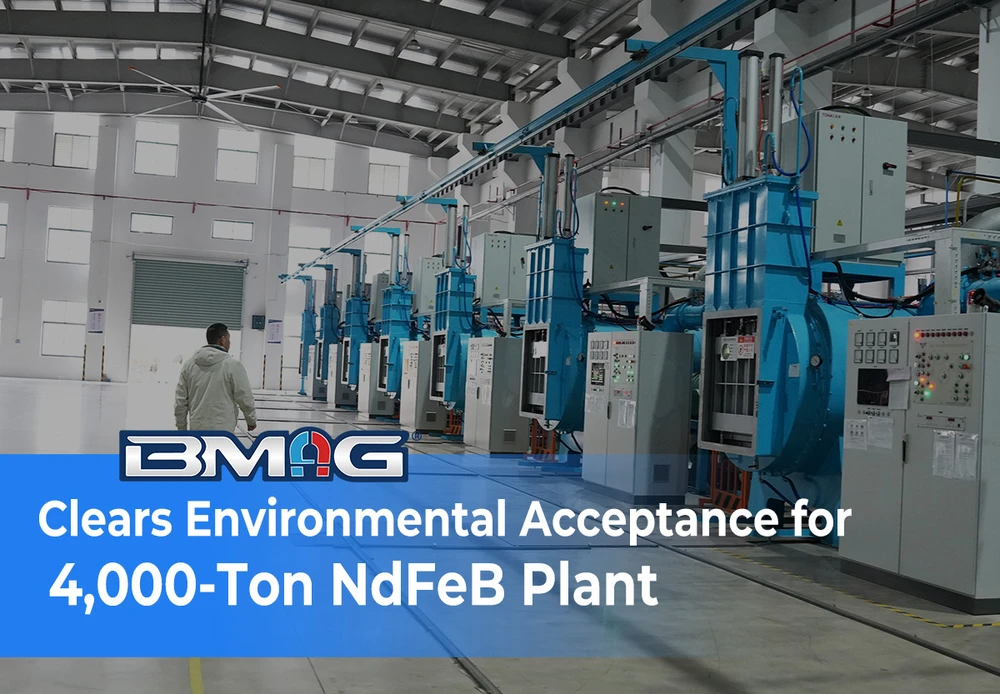
The sintering furnace is the heart of the factory. BMAG utilizes cylindrical, multi-chamber vacuum furnaces.
- Design Logic: These furnaces are cylindrical for a specific structural reason. Operating in a high-vacuum environment (10^-2 to 10^-3 Pa) creates a massive pressure differential between the atmosphere and the furnace interior. A cylindrical body disperses this external pressure evenly, preventing structural deformation and ensuring a perfect vacuum seal.
- Atmosphere Control: The furnace is equipped with precision gas-flow meters to introduce high-purity Argon (Ar) during cooling phases, preventing oxidation while facilitating rapid heat dissipation.
4. Precauciones críticas Pr
Sintering is a “high-stakes” process. BMAG adheres to the following precautions to prevent batch failure:
- Oxidation Control: Even a microscopic leak in the furnace door seal can result in “brown magnets” that lack magnetic strength. We perform routine helium leak detection on all equipment.
- Temperature Uniformity: In a large furnace, the “cold spots” can lead to under-sintered magnets with low density. We utilize multi-point thermocouples to ensure the temperature variance is within ± 5°C across the entire chamber.
- Loading Density: Magnets must be spaced correctly on molybdenum or carbon trays to allow for even radiant heating and gas flow during cooling.
5. Testing and Quality Determination
Once the magnets exit the furnace and cool to room temperature, they undergo rigorous Post-Sintering Performance Testing before any machining takes place.
Equipment: The High-Temperature Hysteresisgraph (Permeagraph)
Utilizamos un High-Temperature Hysteresisgraph to map the full demagnetization curve (the B-H Loop). Unlike a simple Gauss meter, which only measures surface flux, the Hysteresisgraph measures the intrinsic properties of the material.
What We Test After NdFeB Magnets Sintering:
- Remanencia Br: The residual magnetism. If Br is too low, the sintering density is likely insufficient.
- Coercivity (Hcb y Hcj): The resistance to demagnetization. This determines if the aging stages were successful.
- Producto de máxima energía (BH)max: The total energy density. This is the ultimate “strength” rating of the magnet.

Determining Qualification:
A batch is determined to be qualified if it meets the following criteria:
- Grade Specification: The values for Br and Hcj must fall within the defined range for the target grade (e.g., N52 or N42SH).
- Squareness Ratio: The “knee” of the demagnetization curve must be sharp. A “rounded” knee indicates non-uniform grain size or poor alignment during pressing, leading to unstable performance in real-world applications.
- Density Verification: Sample magnets are weighed to ensure they meet the 7.5 g/cm^3 threshold.
Conclusión
The sintering and aging process is where the “magnetic soul” of a BMAG magnet is permanently forged. By mastering the physics of liquid-phase sintering and the microscopic isolation of grain boundaries, we ensure that our magnets provide not just power but long-term reliability.
Would you like me to generate a specific technical datasheet for our N52SH grade to see how these sintering parameters translate into real-world performance?