








In the world of advanced manufacturing, Ímãs NdFeB (Neodymium Iron Boron) are the undisputed heavyweights. Often referred to as “King Magnet,” these sintered materials offer the highest energy density available today. However, when you browse a supplier’s catalog, you’re met with a confusing alphanumeric soup: N35, N42, N52, 35SH, and so on.
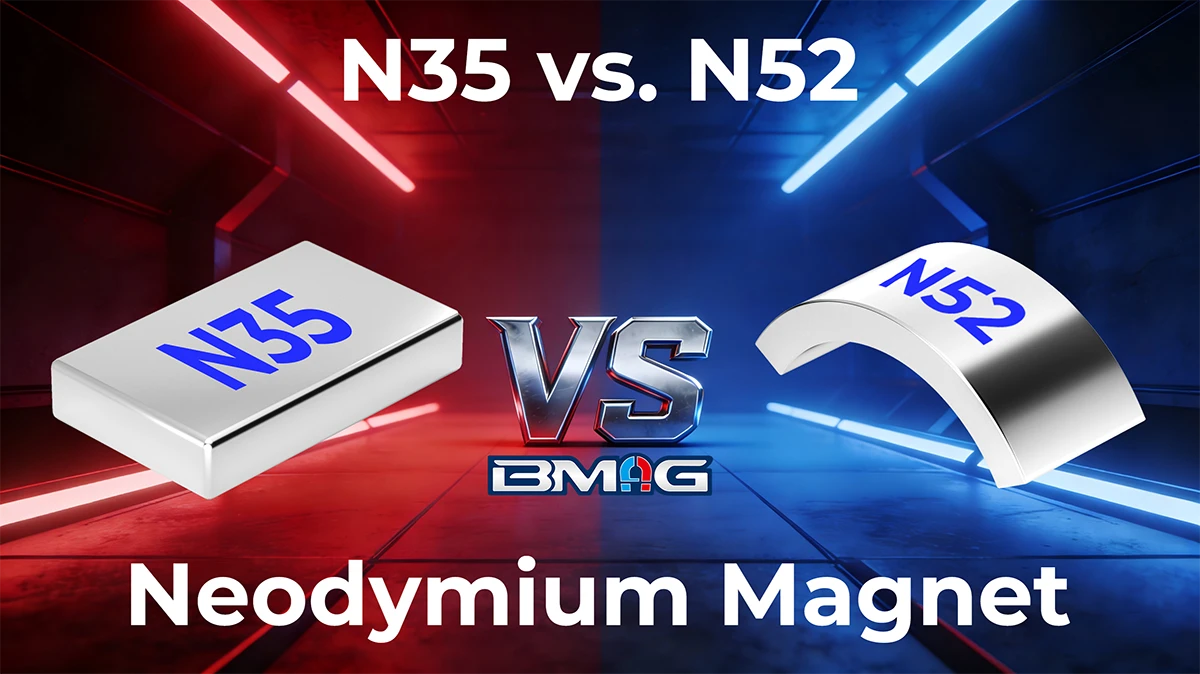
The choice usually boils down to a classic showdown: N35 vs. N52. N35 is the industry workhorse—reliable and cost-effective—while N52 represents the current commercial ceiling of magnetic strength. Choosing the wrong one can lead to either an underpowered product or an over-budget nightmare. This article will deconstruct these performance parameters and provide a clear framework for NdFeB magnet selection, ensuring your application benefits from the perfect balance of power, stability, and cost.
Core Basic Knowledge: Decoding Magnet Grades
Before comparing specific grades, we must understand what “N52” actually signifies. Neodymium magnets are classified by their Energia Máxima Product, measured in Mega-Gauss Oersteds (MGOe).
1. The Anatomy of a Grade
- The Letter “N”: Simply stands for Neodymium. It indicates the material type (Sintered NdFeB).
- The Number: This represents the (BH)máximo (Maximum Energy Product). An N35 magnet has a (BH)máximo of approximately 35 MGOe, while an N52 magnet sits at roughly 52 MGOe.
- The Suffix (Optional): Letters like M, H, SH, UH, or EH indicate the Coercividade intrínseca (Hcj), which tells you how much heat the magnet can withstand before losing its “magic.”
2. Composition and Manufacturing
NdFeB magnets are comprised primarily of Neodymium, Iron, and Boron. By tweaking the ratios of these elements and the sintering process, manufacturers can push the magnetic flux higher (resulting in N52) or prioritize temperature resistance and cost-efficiency (resulting in N35).
The Core Showdown: N35 vs. N52 Performance Analysis
When comparing N35 and N52, it’s helpful to think of them as the “Standard Edition” versus the “Performance Edition” of the magnet world. Here is how they stack up across critical NdFeB magnet performance parameters.
Magnetic Strength and Flux Density
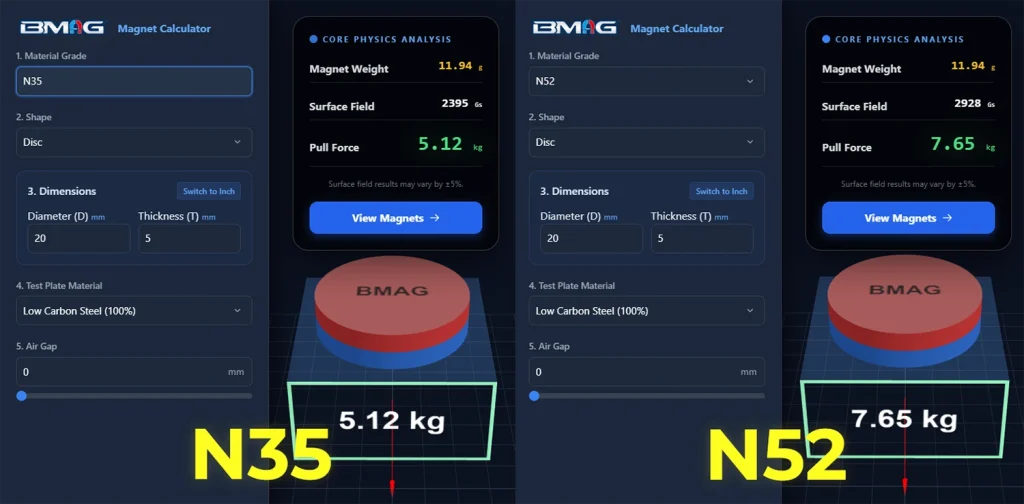
The most obvious difference is pull force. An N52 magnet is roughly 20% to 30% stronger than an N35 magnet of the same physical dimensions. If you have a strict space constraint—such as in a modern smartphone or a miniature drone motor—N52 allows you to achieve the required magnetic field with a significantly smaller footprint.
Cost-Effectiveness and Market Availability
Here is where N35 shines. Because N52 requires higher-purity raw materials and more precise manufacturing tolerances, it is substantially more expensive. Furthermore, N52 is closer to the physical limits of the material, leading to lower production yields. For many industrial applications where size isn’t the primary constraint, using a slightly larger N35 magnet is often more economical than using a tiny N52 magnet.
Physical Characteristics and Durability
All neodymium magnets are naturally brittle, much like ceramic, but higher grades like N52 are notoriously prone to chipping. Their high internal magnetic tension makes them sensitive to mechanical impact. Additionally, both grades require coating (usually Nickel-Copper-Nickel, Zinc, or Epoxy) to prevent oxidation, as the high iron content makes them “rust” if exposed to moisture.
| Featura | N35 Magnet | N52 Magnet |
| (BH)máximo | ~35 MGOe | ~52 MGOe |
| Remanence (Br) | 11.7–12.1 kG | 14.2–14.7 kG |
| Relative Strength | Baseline (100%) | High (130-140%) |
| Custo | Budget-friendly | Premium |
| Best For | General industry, sensors | Aerospace, high-end electronics |
Application Scenarios: Where Does Each Grade Belong?
Choosing between N35 and N52 isn’t just about strength; it’s about application scenario adaptation.
When to Choose N35 Magnet:
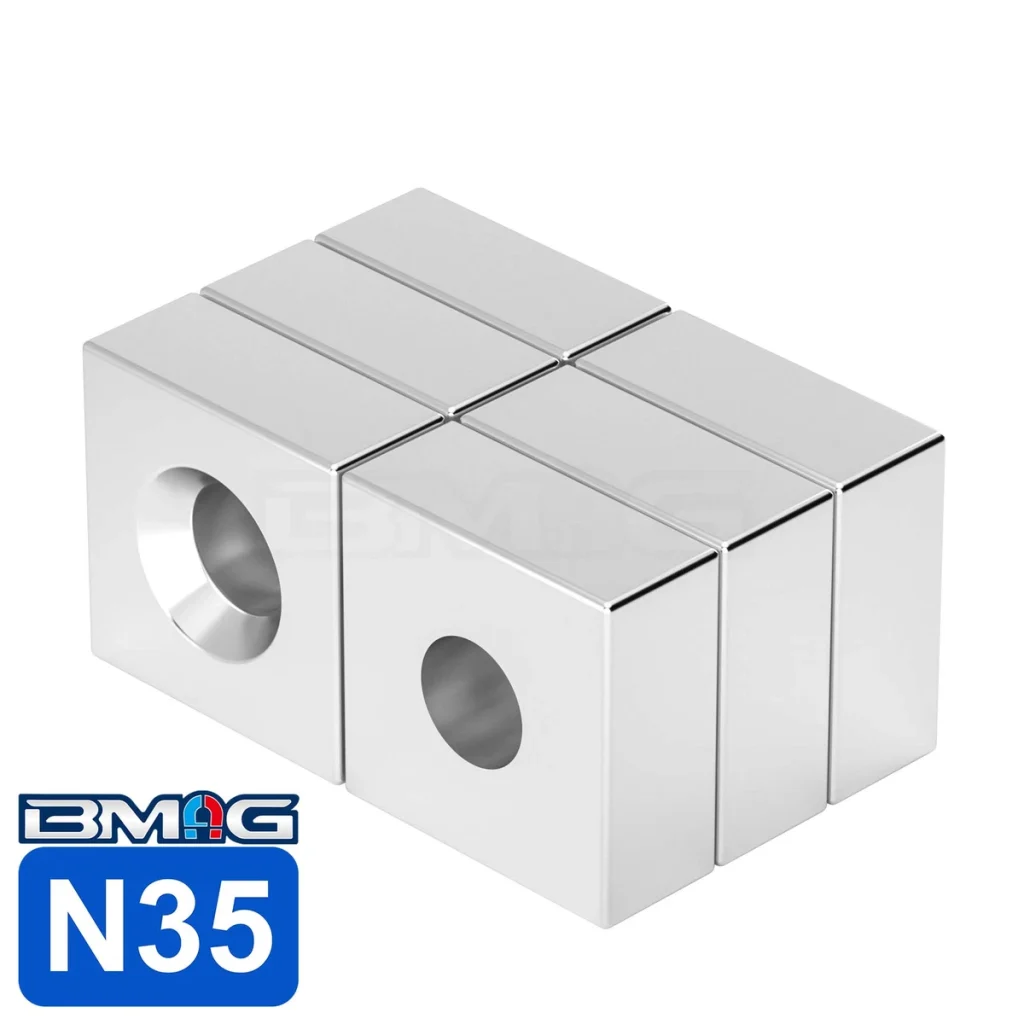
- Consumer Electronics: Household appliances, magnetic catches, and DIY projects where “good enough” strength is preferred over high cost.
- Industrial Sensors: Many Hall-effect sensors don’t require extreme flux; N35 provides a stable, repeatable field at a fraction of the price.
- Education and Hobbyist: Perfect for school science kits or office gadgets where safety (lower pull force) is a consideration.
When to Choose N52 Magnet:
- Miniaturized Technology: If you are designing a medical hearing aid or a micro-actuator, every millimeter counts. N52 provides the highest force-to-volume ratio.
- High-Efficiency Motors: In EV (Electric Vehicle) motors or wind power generators, higher energy density translates directly into better efficiency and weight reduction.
- Research and Development: Aerospace applications often demand N52 to shed every possible gram of weight while maintaining high torque or holding power.
Calculate Magnetic Force
How to determine the appropriate size and specifications of a neodymium magnet before purchasing?
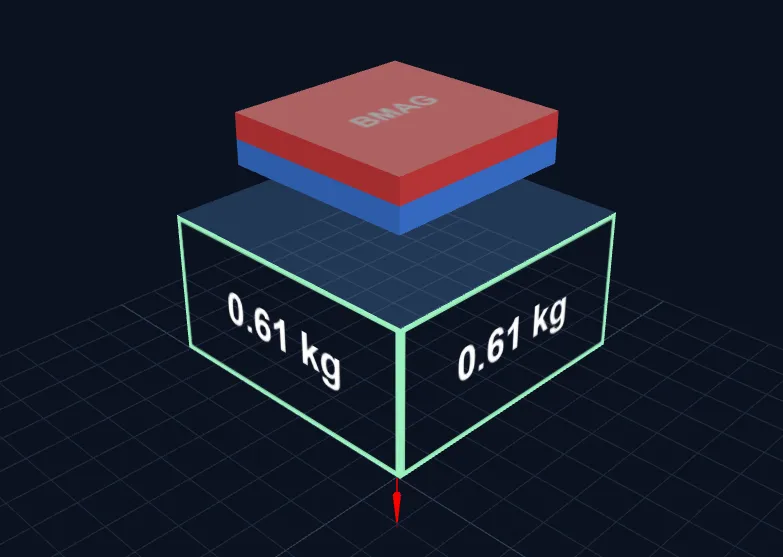
Use a professional magnetic force calculator to compute the pull force and surface field, aiding in selecting the most suitable neodymium magnet.
Selection Skills: A Professional Procurement Framework
To avoid selection mistakes, follow this 5-step NdFeB magnet selection guide:
- Define the Space Budget: If your design is “locked” and the current magnet isn’t strong enough, upgrade to N52. If you have room to grow, a larger N35 will save you money.
- Verify Operating Temperature: This is critical. Standard N52 magnets often have a lower maximum operating temperature (approx. 70°C to 80°C) than N35. If your environment is hot, you may need an N35H or N35SH rather than a standard N52.
- Evaluate the Working Environment: Will the magnet be exposed to moisture or chemicals? Ensure you specify the correct coating (e.g., Epoxy for high humidity).
- Consider Assembly Methods: Since N52 is more brittle, consider how it will be installed. Will it be glued, or “snapped” into place? High-impact assembly can shatter N52.
- Quality Certification: Always ensure your supplier adheres to ISO9001 e RoHS standards. This ensures the “N52” you are buying isn’t actually a “re-labeled N45.”
Frequently Asked Questions (FAQ)
1. Is N52 always “better” than N35?
No. While N52 is stronger, it is more expensive, more brittle, and often has lower temperature resistance. “Better” depends entirely on your specific project requirements and budget.
2. How can I tell if I received N52 or N35?
You cannot tell by looking at them. Testing requires a Gaussmeter to measure surface flux or a Hysteresigraph to measure the full demagnetization curve. Always request a material test report from your supplier.
3. What is the temperature range for NdFeB magnets?
Standard grades (no suffix) are rated for up to 80°C. For higher temperatures, you must look for grades like SH (up to 150°C) or UH (up to 180°C). Note that as temperature resistance goes up, (BH)máximo often goes down.
4. How do I prevent NdFeB magnets from oxidizing?
Since Neodymium magnets contain high amounts of iron, they must be coated. Ni-Cu-Ni is the standard, but for extreme environments, consider Everlube ou Epóxi coatings to prevent corrosion.
5. How do I determine what size magnet I need to meet my specific force requirements?
For a precise calculation of the pulling force and surface magnetic field strength of various magnet specifications and sizes, you can use a professional magnetic force calculator. The BMAG Magnetic Force Calculator helps you quickly estimate the attraction force and surface field for different magnet dimensions, making it easier to select the most suitable magnet for your needs.
Conclusion and Strategic Guidance
Navigating the nuances of N35 vs. N52 is a balancing act between physical performance and economic reality. To summarize:
- N35 is your go-to for cost-sensitive, general-purpose industrial applications.
- N52 is the elite choice for cutting-edge technology where space is at a premium and performance is non-negotiable.
Escolhendo o certo NdFeB magnet grade requires a deep understanding of your mechanical constraints and thermal environment. By following the selection steps outlined in this article, you can optimize your product’s performance while keeping manufacturing costs under control.
Discover Your Perfect Magnet at BMAG Magnet.